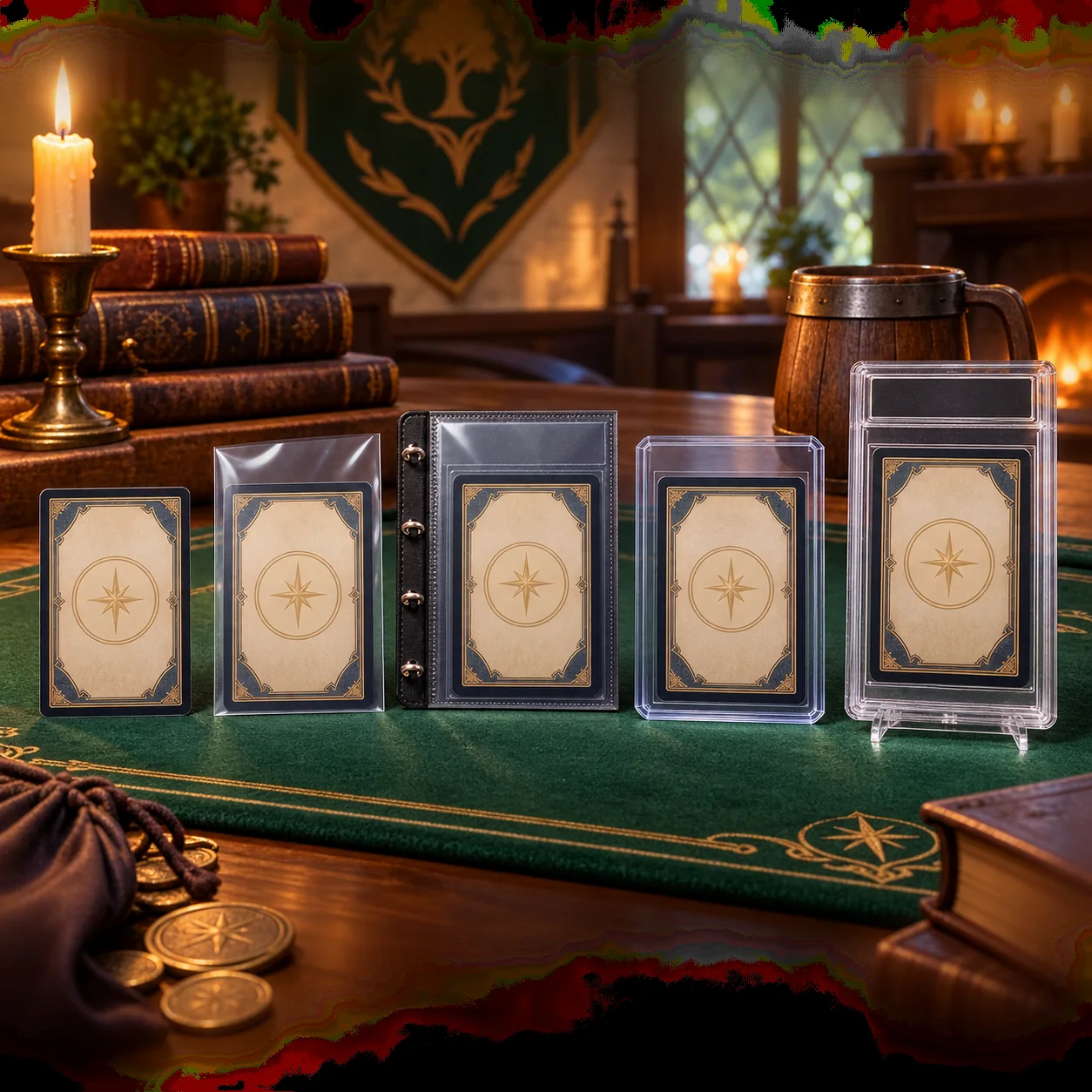
Choose card storage by the damage you need to prevent. A clean soft sleeve protects a frequently handled card from surface wear. A binder organizes a collection. A rigid holder adds bend and impact resistance. A graded slab adds tamper-evident authentication and a standardized label—but it is not necessary for every valuable or beloved card. Good storage is a system: suitable materials, gentle handling, stable temperature and humidity, and protection from light and pressure.
The right level is the lightest one that safely fits how the card will be used.
Level zero: careful handling
Protection starts before the sleeve. Use clean, dry hands. Hold a card by its edges. Clear the surface of food, drinks, grit, and adhesive. Do not press on a card to “flatten” it, and do not experiment with cleaning on anything you would regret damaging.
General preservation guidance from the U.S. National Archives favors a stable environment, low heat, moderate humidity, minimal light, and inert materials in direct contact with paper and photographs. Trading cards have their own inks, coatings, foils, and manufacturing differences, so treat those archival principles as a conservative foundation—not a guarantee for every card stock.
Level one: a soft sleeve for surface protection
A correctly sized soft sleeve is the first useful layer for most collectible cards. It reduces fingerprints, dust, and scuffing during ordinary handling.
Use a new, clean sleeve. If the fit is tight enough to bow the card or catch an edge, stop. Never force a card through friction. Replace a sleeve that is cloudy, dirty, torn, or carrying grit.
A soft sleeve is not rigid. It does little against bending, crushing, or a heavy object dropped on the collection.
Level two: binder storage for an organized collection
A side-loading, archival-quality binder page can make a collection easy to view while limiting repeated removal. Use sleeves made from stable plastics such as polyester, polypropylene, or polyethylene; avoid unknown soft plastics and PVC. Do not overfill pockets or overstuff the binder.
Store the binder upright only when the pages remain fully supported and do not sag. Otherwise, store it flat with nothing heavy stacked on top. Keep it away from direct sunlight, vents, attics, garages, and other places with large environmental swings.
Binders are best for sets and collections you want to browse. They are less convenient for decks that move in and out constantly and less protective than a rigid holder against concentrated pressure.
Level three: rigid holders for individual cards
Top loaders and semi-rigid card holders add structure. Start with a soft sleeve, then insert the sleeved card carefully into the rigid holder. This keeps the harder plastic from rubbing directly against the card surface.
Use a holder that matches the card's thickness. An undersized holder can pinch; an oversized holder can let the card slide and strike the edges. A team bag or other clean outer enclosure can reduce dust and keep a top loader from releasing the card during transport.
Semi-rigid holders are often used for grading submissions. Follow the grading company's current packaging instructions rather than copying an old video. PSA's own show-submission guidance, for example, describes a soft sleeve or Mylar before a Card Saver-style holder. Requirements can change, so recheck before packing.
Level four: magnetic holders and display cases
Magnetic holders can present a card beautifully and add rigidity. They must be the correct thickness, clean, and free from debris before the card is placed inside. Some collectors use an inner sleeve designed for the holder; others prefer a precisely fitting recess. Either way, the card should not rattle or be compressed.
Display creates a new risk: light. The Library of Congress recommends minimal light and no direct or intense light for vulnerable paper collectibles. “UV protected” does not mean “sunlight proof.” Rotate displays and keep them away from windows and heat sources.
Level five: a graded slab
A professional slab can combine authentication, an assigned grade, a standardized label, and a sealed rigid holder. It can be useful for cards you plan to sell into a grade-sensitive market, cards with authenticity concerns, or pieces whose documented condition matters to the collection.
A slab does not make a card valuable, guarantee a profit, or stop all environmental damage. The grading fee, shipping, insurance, declared value, turnaround time, and the possibility of a disappointing grade all belong in the decision. Read our grading guide before submitting.
For your own records, My Tavern's Slab Vault can organize graded-card information. The My Tavern guide explains how that private collection view fits with the portfolio and wishlist tools.
Match protection to the card's job
Use this quick decision rule:
- Deck card: play sleeve, appropriate deck box, and regular sleeve replacement.
- Set binder card: clean soft sleeve plus a stable, not-overfilled binder page.
- Trade or transport card: soft sleeve plus a correctly sized rigid or semi-rigid holder.
- Display card: rigid display holder, controlled light, stable environment.
- Potential grading submission: minimal handling, documentation, and the grader's current required holder and packing method.
- Irreplaceable sentimental card: conservative enclosure, stable storage, and fewer handling cycles—even if its market price is modest.
Build the environment, not just the enclosure
The most expensive holder cannot rescue a card from a hot car, a leaking basement, direct sun, or constant pressure. The National Archives recommends keeping family papers and photographs below 75°F, below 65% relative humidity, and above extremely dry conditions that can promote brittleness. For a home collection, the practical message is stability: a comfortable interior room, away from water, heat, and rapid swings.
Inspect storage a few times each year. Look for bowing, condensation, sleeve clouding, binder pressure, dust, or a musty odor. If something changes, move the collection to a safer environment before experimenting with the card itself.
The best storage is quiet. It lets the collection wait safely until the next game, trade, display, or story.
Protect the collection
Match every card to the right level of care.
Browse current storage supplies or review the Tavern’s card-service options before handling a high-stakes card.